
Homemade chicken stock is my secret weapon in the kitchen. And it wouldn’t be Sunday in our house without a pot of broth on the stove. It warms up the house, wafts a subtle homey aroma into the air and honestly, soothes my soul a little.
But I am not a kitchen prima donna. I do not home-roast the bones of a grass-fed organic bird. I use a big, juicy Costco roasted chicken with no apologies. And I don’t think you sacrifice a bit of taste by skipping the roasting yourself. I mean, Costco roasts it, right? And then I can move on to the more fun stuff. Maybe I’m a food snob in the sense that I like real food prepared with care. But I’m not a haughty chef de cuisine wannabe who does something the hard way only because it’s hard.
Store-bought roasted chicken has some distinct advantages to my way of thinking. It’s reliably well cooked and it has that delicious roasted brown skin. I contend this is where a ton of the flavor comes from. Then you just have to know the basic mechanics of a slow simmer and of aromatics to get a dynamite broth every time.
I don’t just use broth for soups. I use it for rice, in mashed potatoes and for a flavor base for sauces. And if my family isn’t feeling great, a cup of warm, homemade broth works miracles. So I make a lot of it. And after years of doing it, I’ve learned that great chicken broth really comes down to a few simple things.

1. Pull and sort the chicken. When I start to pull that Costco chicken, a humble bird transforms into many meals before my eyes. But there is no pretty way to do it. Just get in there. I use a knife to separate the breasts from the breastbone, but after that, it’s mostly ripping and sorting. Bones, skin, wings and all the little icky bits I don’t want to serve for dinner go straight into the stockpot. That’s flavor.
While my hands are still covered in chicken muck, I pull the meat into bite-size pieces for the meals I have planned. This way, I don’t have to get ick-ed up twice. Into bags, into the refrigerator or freezer, done.
2. Leave your veggies rough–VERY rough. There is no reason to peel and perfectly dice your carrots, onions, garlic and celery. Give anything dirty a rinse, then hack that onion in half and throw it in. Smash those garlic cloves with gusto and chuck them in the pot, skins and all. I cut carrots and celery into 2-ish inch pieces or sometimes I just break them with my hands. Everything gets strained out anyway, and the stock doesn’t care if it’s beautiful. It cares that it’s GOOD!


3. Watch the pot carefully at first. Nothing breaks my heart quicker than a cloudy, milky stock, and that happens when you let it boil too rapidly. For a beautiful, clear stock, the liquid should be barely moving—a lazy bubble here and there, not a rolling boil. It takes a little fiddling to find the sweet spot.
I start mine on high and watch closely until it’s just about to boil, then immediately turn the heat way down. That’s Lo on one of my burners and Simmer on another, so you’ll need to play with yours until you find the right setting. Leave it for 3 to 4 hours. I sometimes let mine go longer when I want a richer, more concentrated stock. Add more water as needed to keep bones or veggies mostly submerged.
4. The “Chicken-y” Done Test–I always taste my stock to know if it’s done. My very scientific test is whether it tastes very “chicken-y.” 😀 You should be able to taste both chicken and fat without it being greasy, and it should be flavored well by the aromatics. If you like what you taste, you are ready to strain, season and store.
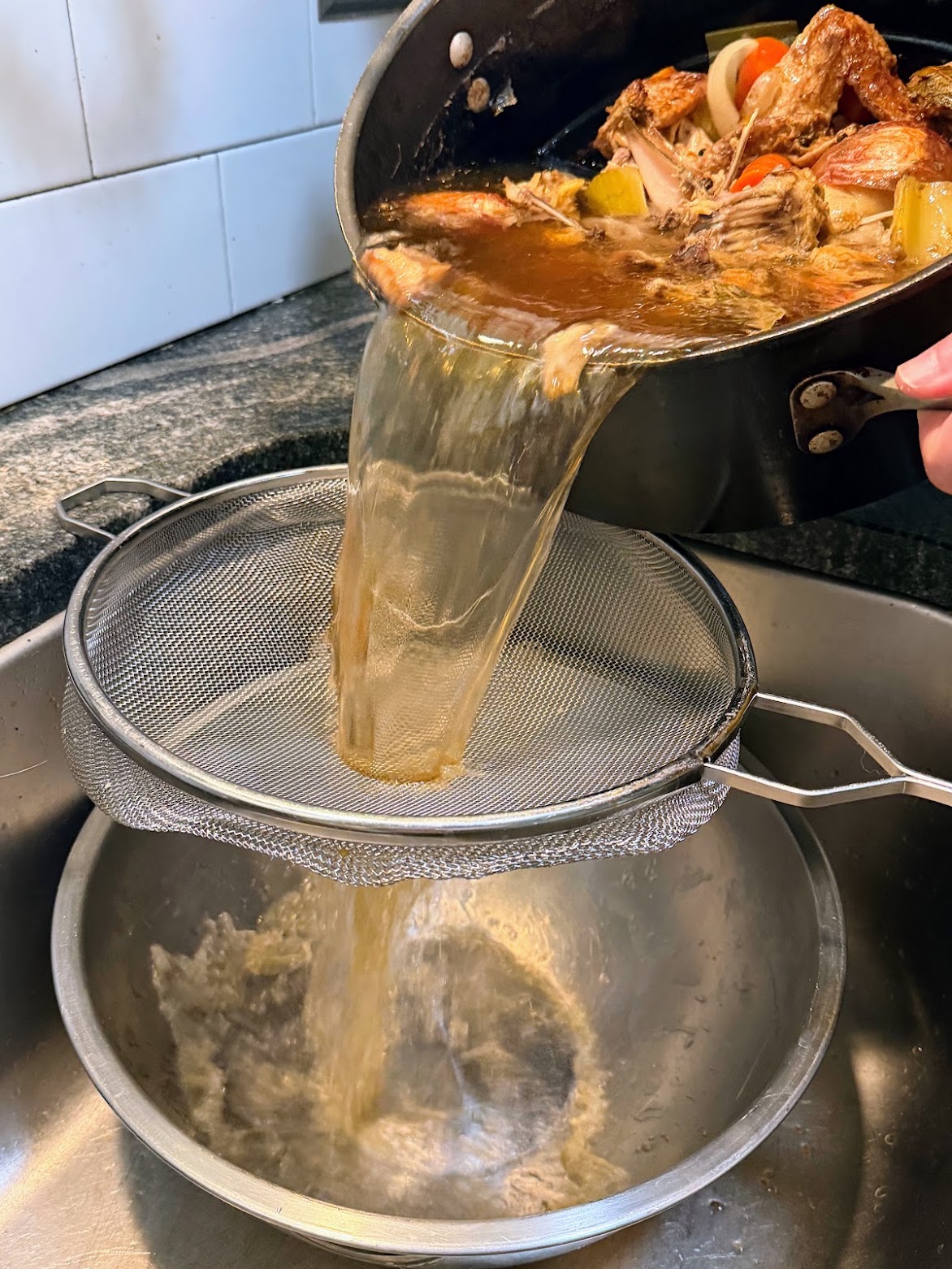
Strain, season and store–Let the broth cool slightly, then strain out all those spent bones and vegetables. What you’re left with is about six cups of glistening, golden broth. Taste it. I often gild the lily with a little butter at the end, but I don’t salt my broth. I’d rather season it according to whatever I’m using it for. I usually freeze it in 2-cup containers because that’s what I reach for most often in recipes. But I’ve stored it just about every way you can imagine.


By the time I’m done, one Costco chicken has made two pesto chicken tortellini lunches for my husband, a pot of chicken chili and stocked my freezer with broth for meals I haven’t even thought of yet.
One bird. Many meals. That’s how I like to run my kitchen.